
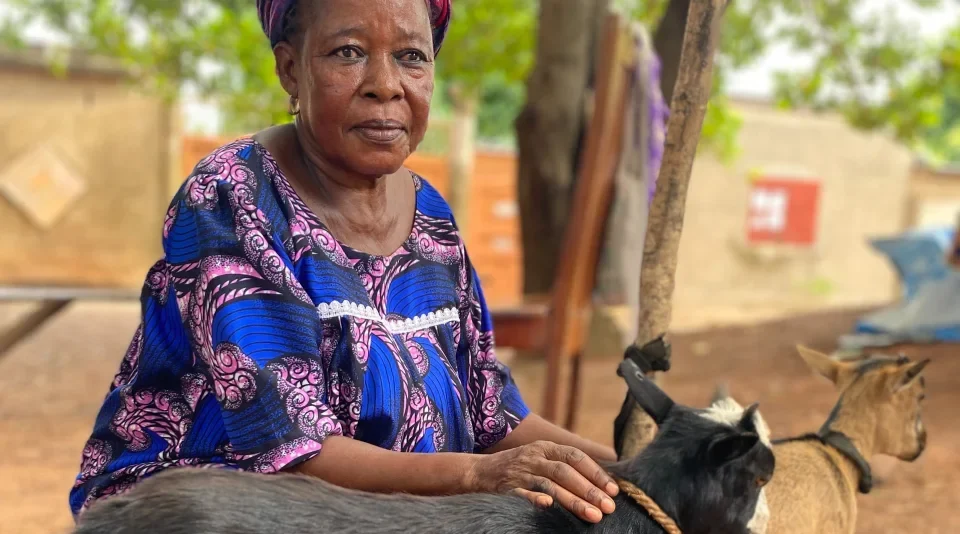
Goats bring gospel hope to widows in Benin
Widows in Benin are rebuilding their lives through an unexpected gift: two goats that offer income, dignity and the reminder that they are deeply loved by God.
By Millie Faulkner-Bugg
The gift of two goats is transforming the lives of widows in Benin.
It began just a couple of years ago, when a donor approached SIM worker Lucia Eberle wanting to provide goats for vulnerable women. At first, Lucia, who leads the Dorcas ministry supporting widows across West Africa, wasn’t sure what to make of the idea.
“When everything has been taken from you, to own something alive, something that grows, it means the world.”
“We’d never thought about a goat project before,” she says. “So we started looking into it.”
For many widows in Benin, the death of a husband brings far more than grief. Some lose their homes, possessions and even their children as members of their husband’s family claim everything they own. Many are left isolated, stigmatised and under pressure to remarry, sometimes within the same family.
Even in church, people may keep their distance, fearing the stigma and thinking, “I might be next.”
Lucia said: “They become not only cast away by society, but they feel like they have no real reason to live, except to battle for their kids.”
“When everything has been taken from you, to own something alive, something that grows, it means the world.”
That was the power of two goats – the power that gave the widows hope, a potential livelihood and a reason to carry on.
The response to the first goat project in Parakou was overwhelming. Not only did the widows embrace the opportunity, but the impact encouraged further support, leading to a second project in Djougou, where 15 widows each received two goats.
Before receiving their goats, each woman takes part in training led by a local partner organisation, learning how to care for the animals, recognise illness and use them to provide for their families through breeding, milk and meat production.
Yet Lucia says one of the greatest impacts came from something she had never expected.
After one distribution, a widow stayed behind to speak with the local Dorcas leader. Having lost almost everything after her husband’s death, she explained what the goats meant to her.
The leader shared her words: “They’re her goats. Not her husband’s. Not the family’s. Hers.”
For the first time in years, she owned something that nobody could take away.
The goats provide an income and the opportunity to build a more secure future. Some have already given birth, multiplying the blessing for the families who care for them.
“They’re her goats. Not her husband’s. Not the family’s. Hers.”
But the project also restores something less tangible. It restores dignity.
“The training itself is important,” Lucia explains. “The widows spend time learning together, eating together and asking questions. They’re treated as people who matter. They realise they’re not forgotten.”
“The goats are important,” she says. “But even more important is that these women know they are deeply loved by God.”
For women who once believed they had been forgotten, two goats have become far more than livestock. They have become a reminder that their lives have value, their future has hope and they are precious in the sight of their heavenly Father.
“But even more important is that these women know they are deeply loved by God.”
Please pray
-
For the widows in Parakou and Djougou, that the goats would continue to provide stability, income and renewed dignity as they rebuild their lives.
-
For Lucia and the Dorcas teams across West Africa, for wisdom, strength and compassion as they walk closely with widows who carry deep grief and isolation.
-
For future goat projects, that God would provide the right timing, resources and partnerships so more women can experience ownership and the reminder that they are seen and loved by their heavenly Father.
You might also like
Meet Lily and Peter, two children growing up in North Africa. They share what everyday life is like, from school and friendships to faith, family, hobbies ...
For Tony, sharing Jesus in the Middle East starts with friendship. From watching football on the street to learning Arabic, he is building relationships wi...
A look at North Africa’s diverse nomadic groups, how modern pressures are reshaping their lives, and the meaningful ways Christian believers can serve am...
The Middle East and North Africa are home to hundreds of millions of people who have never heard the truth of Jesus. God is opening remarkable doors across...
Across North Africa, Amazigh communities are reclaiming their language, culture and identity. As they rediscover their heritage including a largely forgott...
Richard and Valérie Morris have spent decades helping mission workers understand the spiritual realities they may face — from confronting fear and oppre...
Mission worker Dominique has spent the past eight months serving women in Nigeria’s Plateau State, where hundreds of widows are rebuilding their lives af...
We asked mission worker Ryan, how do learn to love the people and culture you serve?
You don’t need a passport to be part of God’s global work. From prayer and financial partnership to elevating mission stories in your church, here are ...
A statement from Kevin and Krista Rideout.
Galius had a tough childhood in Namibia. He lost his mother at childbirth and his father also passed away when he was a teenager. Today, Galius is st...
They come for the games, but they leave with something far greater. Across the world, Sports Friends camps are creating opportunities for young people to d...